Children and Young Persons (Harmful Publications) Act 1955
A History of the Vampire in Popular CultureThe Children and Young Persons (Harmful Publications) Act 1955 was the legislative afterlife of the Gorbals Vampire incident: a mass panic among Glasgow schoolchildren became the principal justification for regulating horror comics across the United Kingdom. Its importance lies less in the rarity of prosecutions than in the way it transformed a disputed cultural fear into a durable category of legal harm, treating illustrated stories as a potential danger to young readers even when they were not sexually obscene.
Origins in the Gorbals Vampire Incident
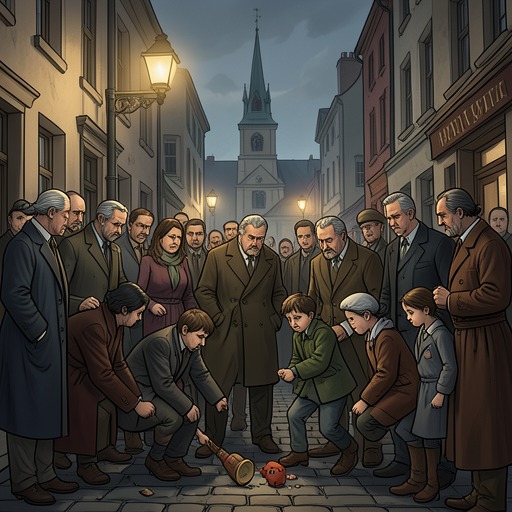
The immediate background was a reported vampire hunt in Glasgow in September 1954. Rumours claimed that a vampire with iron teeth had killed two local children and was still seeking further victims, although there had been no reports of child murders or disappearances that year. On the night of 23 September, hundreds of children gathered in the Southern Necropolis, a neglected cemetery containing nearly a quarter of a million graves. Many carried stakes and knives; some brought dogs. Police attempting to disperse them were overwhelmed by the size and excitement of the crowd.
The incident became a national story when the Daily Mirror placed it on its front page on 25 September under the headline “AMAZING SCENE AS HUNDREDS OF CHILDREN STORM A CEMETERY,” adding the sub-heading “The Toddlers Joined In.” The newspaper’s account presented the children’s fear as both absurd and theatrically alarming. Children reportedly clung to the reporter and urged him to kill the vampire so they could sleep. The story’s circulation enlarged the event beyond the cemetery, making it available as evidence in a national argument about childhood, popular entertainment, and social control.
The supposed source of the panic was contested. Public discussion blamed imported American horror comics, and Glasgow’s Education Officer, Dr H.S. Mackintosh, argued that such publications had exceeded acceptable limits. Mothers likewise connected the comics with children’s fear, including one account of a seven-year-old who ran home crying and demanded that every window be closed against the vampire. Yet a more local explanation was also available: the cemetery backed onto Dixon’s Blazes ironworks, whose furnaces cast red light and smoke across the graves, making gravestones seem to leap and figures appear to move. The legend may therefore have grown from an interaction among landscape, industrial light, oral tradition, children’s imagination, and press amplification rather than from comics alone.
From Public Alarm to Legislation
The political response developed quickly. On 1 October 1954, Alice Cullen, then the Member of Parliament for the Glasgow constituency of Gorbals, was quoted as asking Home Secretary Sir David Maxwell Fyfe to introduce legislation banning the sale of horror comics. The request followed the cemetery episode and gave parliamentary form to an anxiety that newspapers had already framed as a national emergency. By 27 September, the Daily Mirror was openly suggesting that Glasgow civic and welfare leaders might seek a complete ban, claiming that American horror comics were responsible for the hysteria.
The campaign also gained force from further reports of children behaving aggressively toward supposed outsiders. On 1 October, a family of travellers was attacked at its caravan by children throwing stones and shouting that the occupants were witches. The newspaper described a crowd that may have numbered about 300 children and again attributed the disturbance to the influence of “dreadful comics.” This expansion of the story illustrates the mechanism of moral panic: a single frightening rumour becomes a general explanation for unrelated fears, while the alleged medium is treated as the source of disorder.
The legal problem was that British law did not clearly recognize harmful horror as a form of obscenity. A confidential government memorandum of 25 November 1954 noted that the Obscene Publications Act 1857 generally treated “obscene” material as graphically sexual. Horror comics could be regarded as harmful without fitting that established definition. The proposed solution was not simply to classify them as obscene, but to create a parallel power allowing courts to suppress illustrated works considered dangerous to children and young persons.
Scope and Wording
Introduced by Home Secretary Gwilym Lloyd George in May 1955, the Act came into force on 6 June. Its target was defined broadly as any book, magazine, or similar work likely to fall into the hands of children or young persons and consisting wholly or mainly of stories told in pictures, whether or not written matter was also included. The law focused on content portraying the commission of crimes, acts of violence or cruelty, or incidents of a repulsive or horrible nature.
The decisive threshold was the effect attributed to the work as a whole: the publication had to be presented in a way that would tend to corrupt a child or young person into whose hands it might fall. This wording made the Act more flexible than a narrow list of forbidden images. It allowed attention to shift from an isolated panel to the cumulative impression of a publication, while also leaving considerable room for interpretation about what counted as corruption, horror, or likely circulation among children.
The government’s position was explicitly paternalistic. The relevant comics were said not to be obscene under existing law, yet “just as harmful, if not more harmful to children and young persons” than obscene publications. The proposed remedy was to give courts comparable power to prevent their circulation. The distinction established a hierarchy of harm in which sexual obscenity was no longer the only material danger that could justify censorship; violence, cruelty, and repulsive imagery could independently trigger state intervention.
Enforcement and Historical Afterlife
The Act was passed almost entirely because of the activity associated with the Gorbals Vampire incident. Samples of the supposedly offensive comics were sent to Prime Minister Winston Churchill. To modern eyes, the collection reportedly included comparatively ordinary stories about cowboys and private detectives alongside Frankenstein and Captain Marvel, but the publications were nevertheless judged unsuitable. The episode shows how the political meaning of the comics could outweigh the specific contents of the examples selected against them.
Despite the vagueness of its final test, the Act remains in force. There have been barely any prosecutions brought under it, perhaps partly because its language is difficult to apply consistently. Its continuing existence therefore has a significance separate from frequent courtroom use. It preserves a legal readiness to intervene against illustrated narratives when authorities believe that their mixture of crime, violence, cruelty, or horror may corrupt young readers.
The Act belongs to a wider history of vampire and horror fears being converted into institutional action. In earlier periods, disease and unexplained death encouraged communities to exhume corpses, stake supposed vampires, or burn bodily organs, as in the Mercy Brown vampire exhumation and the Serbian vampire panic. In the twentieth century, the feared object shifted from the corpse to the medium: the danger was no longer primarily an undead body returning to a household, but a printed image entering a child’s imagination. The continuity lies in the search for a controllable target when fear appears causeless; the change lies in the authority claimed by newspapers, educators, politicians, and courts.
Cultural Significance
The Children and Young Persons (Harmful Publications) Act 1955 demonstrates how media can magnify a local legend and how policy can then answer the magnified version rather than the original event. The Gorbals children did not provide evidence that a vampire had killed anyone, and the apparent visual source of the cemetery legend may have been the red glow and smoke of a nearby ironworks. Nevertheless, the press made the incident legible as proof of a broader social threat, while political actors used it to argue that horror comics required exceptional treatment.
The law also reveals the unstable boundary between entertainment and social danger. In an era already marked by rapid technological change, spiritualism, revived supernatural belief, and anxiety about cultural transformation, illustrated horror became a convenient symbol of influence that adults could imagine monitoring. The Act’s emphasis on children made that symbol especially potent: young readers were represented not as interpreters of fiction but as vulnerable subjects whose conduct and moral development might be altered by images.
Its history is consequently not only about comics. It is about the production of “harm” through a chain linking rumour, frightened witnesses, sensational journalism, educational authority, parliamentary pressure, and legal language. The Act gave that chain a lasting institutional form, even though the event that prompted it remains better explained as a mixture of local folklore, industrial surroundings, childhood excitement, and media-driven moral panic than as evidence of supernatural violence.